Artificial Intelligence has become more accessible than ever. Organizations can now choose from hundreds of AI platforms, cloud services, and large language models without building everything from scratch. As AI technology continues to evolve rapidly, many businesses assume that choosing the latest or most powerful model is the key to success.
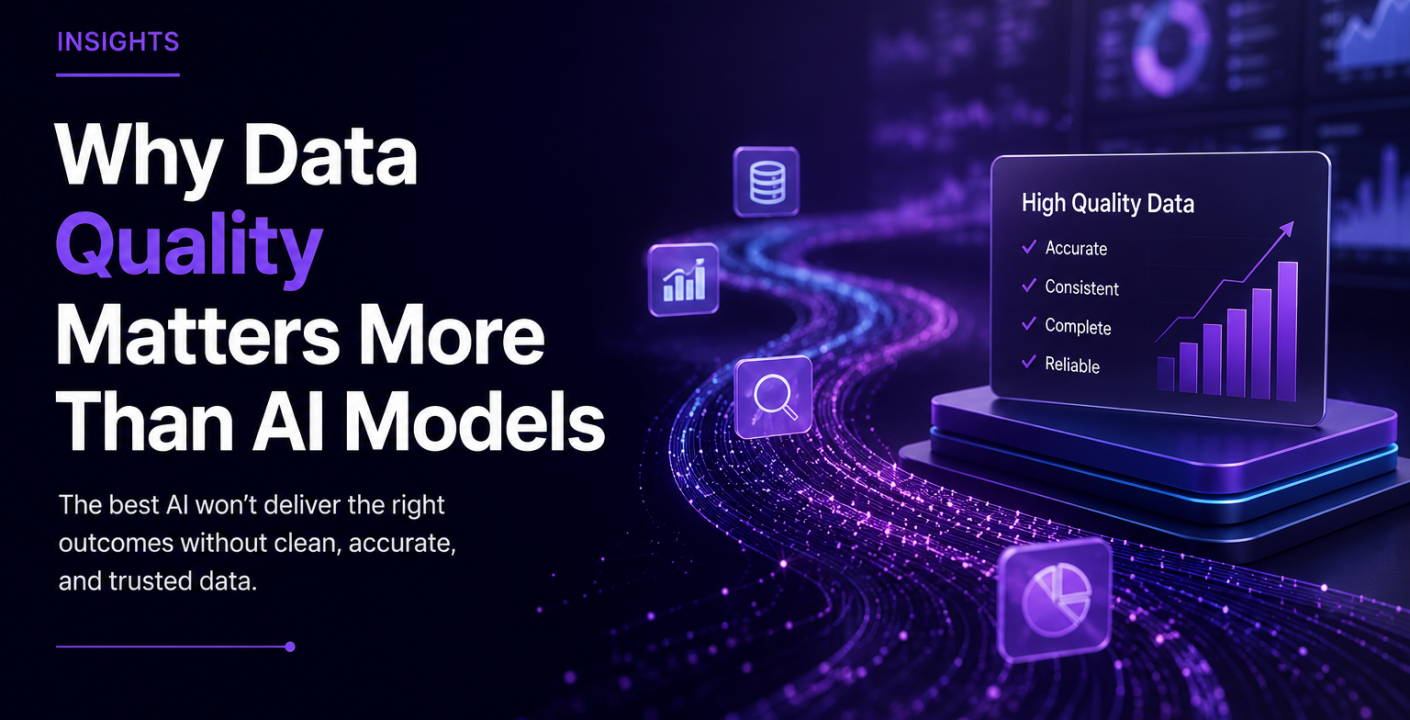
In reality, experienced AI teams know that the quality of the data matters far more than the sophistication of the model itself.
Even the most advanced AI systems cannot consistently produce accurate, reliable, or useful results when they are trained on incomplete, inconsistent, duplicated, or outdated information. High-quality data is the true foundation of every successful AI initiative.
Organizations that invest in improving their data often achieve significantly better business outcomes than those that simply invest in newer AI technology.
1. AI Models Are Becoming Commodities
Only a few years ago, implementing Artificial Intelligence required large research teams, expensive infrastructure, and highly specialized expertise.
Today, organizations can access world-class AI models through cloud platforms within minutes. Whether using OpenAI, Anthropic, Google, Azure AI, or Amazon Bedrock, businesses have more choices than ever before.
This means AI technology itself is becoming increasingly standardized.
Competitive advantage no longer comes from simply choosing a better model. Instead, it comes from how organizations prepare, organize, and leverage their own business data.
Companies that maintain accurate customer records, clean operational data, and standardized business information consistently outperform organizations relying on poor-quality datasets.
2. Poor Data Produces Poor Results
Artificial Intelligence learns from patterns found in data.
If that data contains errors, duplicates, missing values, or outdated information, AI systems simply learn incorrect patterns.
Common problems include:
- Duplicate customer records
- Missing product information
- Incorrect pricing
- Inconsistent naming conventions
- Outdated inventory data
- Poor document formatting
When organizations experience poor AI performance, they often blame the technology.
However, the real issue frequently lies within the underlying data rather than the AI model itself.
Poor data leads to:
- Inaccurate recommendations
- Unreliable predictions
- Reduced employee confidence
- Increased manual corrections
- Higher operational costs
- Slower decision-making
Improving data quality often produces immediate business benefits, even before AI is introduced.
3. The Hidden Cost of Dirty Data
Many organizations underestimate how much poor-quality data costs every year.
Employees frequently spend hours searching for documents, correcting spreadsheets, merging duplicate information, or manually validating reports.
These repetitive activities reduce productivity and delay important business decisions.
Hidden costs of poor data include:
- Wasted employee time
- Duplicate business processes
- Compliance risks
- Customer dissatisfaction
- Reporting inaccuracies
- Inefficient workflows
Organizations that invest in cleaning and governing their data often reduce operational costs while improving overall business performance.
4. Building a Strong Data Foundation
Successful AI projects begin with strong data governance rather than advanced algorithms.
Before selecting an AI platform, organizations should understand:
- Where business data originates
- Who owns each dataset
- How information is validated
- How frequently data is updated
- Which systems share the same information
- How security and compliance are maintained
A mature data strategy typically includes:
- Data ownership
- Standardized formats
- Validation processes
- Secure access controls
- Continuous monitoring
- Governance policies
These practices ensure AI systems receive reliable information that supports accurate decision-making.
Instead of constantly correcting AI-generated outputs, organizations can focus on creating measurable business value.
5. AI Success Starts Before Model Selection
One of the biggest misconceptions surrounding Artificial Intelligence is that better technology automatically produces better results.
In reality, successful AI implementation starts long before model selection.
Organizations should first:
- Organize existing business data.
- Remove duplicates and inconsistencies.
- Define clear business objectives.
- Establish governance processes.
- Select the most appropriate AI solution.
Following this approach significantly reduces implementation risks while increasing long-term return on investment.
Technology continues to evolve rapidly.
Well-managed business data remains valuable regardless of which AI platform organizations adopt in the future.
Conclusion
Artificial Intelligence is transforming how organizations operate, but technology alone is never enough.
The organizations achieving the greatest success are those that prioritize data quality before investing heavily in AI platforms.
Clean, consistent, and well-governed information enables more accurate predictions, smarter automation, and greater confidence in AI-driven decision-making.
Before asking which AI model your business should use, ask a more important question:
Is your data ready for AI?