Artificial Intelligence has transformed how businesses think about automation. For years, organizations relied on traditional automation tools to eliminate repetitive tasks and improve operational efficiency. Today, AI Agents are introducing a new generation of intelligent automation capable of understanding context, making decisions, and collaborating with people.
Although the terms “AI Automation” and “AI Agents” are often used interchangeably, they represent two fundamentally different approaches.
Understanding this difference is essential before investing in modern AI solutions.
This article explains how AI Agents differ from traditional automation, where each approach delivers the most value, and how organizations can determine which solution best fits their business needs.
1. Traditional Automation Follows Fixed Rules
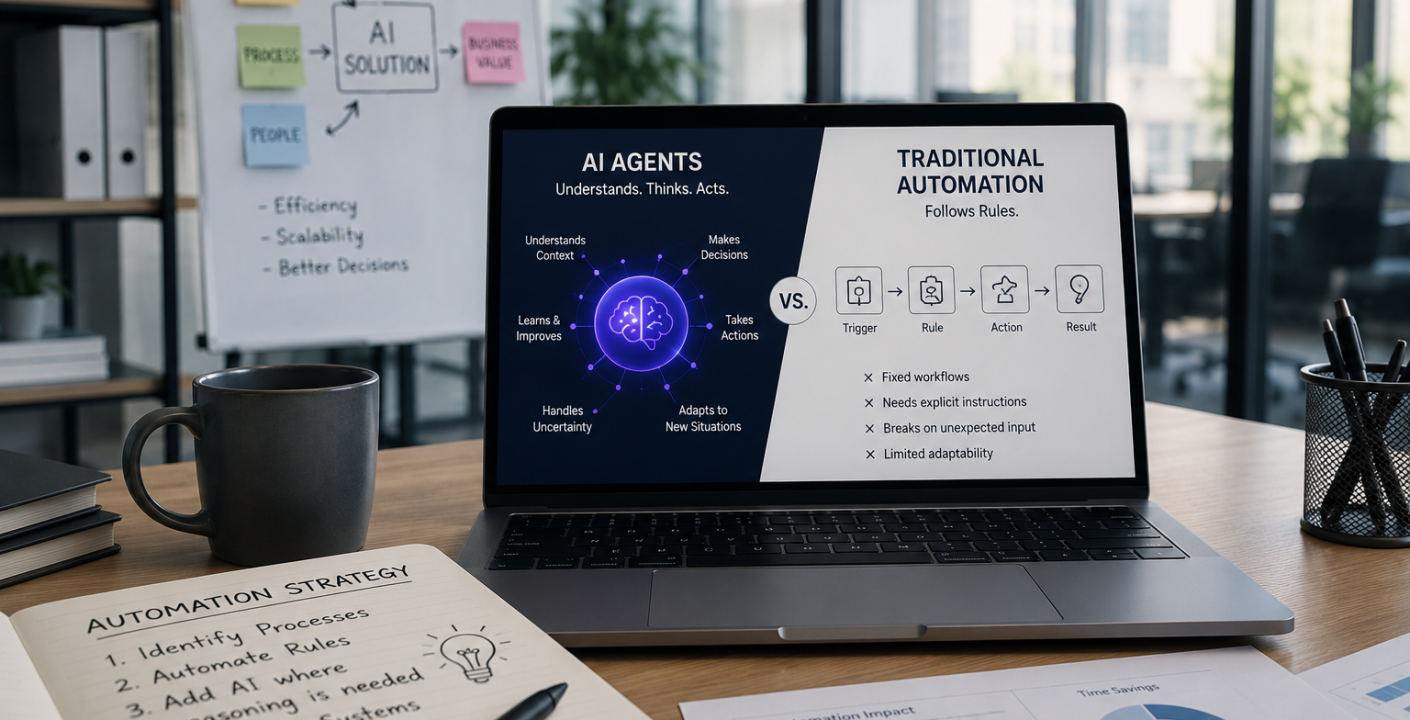
Traditional automation is designed around predefined workflows.
It performs the same sequence of actions every time certain conditions are met. The logic is predictable, structured, and highly reliable.
For example, a workflow might:
- Receive a customer order.
- Generate an invoice.
- Send a confirmation email.
- Update the CRM.
Every step follows predefined rules.
If something unexpected happens, the automation usually stops or requires human intervention.
Traditional automation works best when business processes rarely change and inputs are highly structured.
Common use cases include:
- Invoice processing
- Employee onboarding
- CRM synchronization
- Data migration
- Email notifications
For repetitive business operations, traditional automation remains one of the most cost-effective investments.
2. AI Agents Can Understand Context
Unlike traditional automation, AI Agents are designed to reason rather than simply execute instructions.
Instead of following a rigid workflow, they evaluate information, understand user intent, and determine the next appropriate action.
For example, consider a customer asking:
“I’d like to postpone next month’s shipment because our warehouse is currently full.”
A traditional automation may fail because the wording doesn’t exactly match predefined conditions.
An AI Agent can understand the request, retrieve customer information, identify the correct shipment, update the schedule, and notify the logistics team- all without requiring explicit programming for that exact sentence.
This ability to interpret natural language dramatically expands the range of problems automation can solve.
3. AI Agents Learn From Information, Not Rules
Traditional automation depends on explicit instructions.
Developers define every possible scenario in advance.
AI Agents operate differently.
They combine Large Language Models (LLMs), retrieval systems, APIs, and business logic to evaluate information before responding.
Instead of asking:
“Which workflow should run?”
An AI Agent asks:
“Based on everything I know, what is the best action?”
This allows AI Agents to:
- Summarize documents
- Compare contracts
- Generate reports
- Answer internal questions
- Assist employees
- Coordinate multiple business systems
Rather than replacing workflows, AI Agents make workflows more intelligent.
4. AI Agents Are Better at Handling Uncertainty
Business environments are rarely perfect.
Customers phrase requests differently.
Documents vary in format.
Business rules evolve.
Unexpected situations happen every day.
Traditional automation struggles whenever inputs deviate from predefined patterns.
AI Agents are designed to operate in these uncertain environments.
For example, an AI Agent can:
- Extract information from contracts with different layouts.
- Interpret emails written in multiple languages.
- Identify missing information before continuing.
- Recommend the next action based on business policies.
This flexibility makes AI Agents particularly valuable for knowledge-intensive work.
5. The Best Solution Often Combines Both
Many organizations believe they must choose between AI Agents and traditional automation.
In reality, the most successful implementations combine both.
Traditional automation remains responsible for predictable business processes.
AI Agents enhance decision-making whenever interpretation or reasoning is required.
For example:
Customer submits an email.
↓
AI Agent classifies the request.
↓
Traditional workflow creates a ticket.
↓
AI Agent drafts a response.
↓
Workflow sends the approved email.
This hybrid approach combines the reliability of automation with the intelligence of AI.
When Should Your Business Use AI Agents?
AI Agents provide the greatest value when work involves:
- Natural language
- Multiple information sources
- Human decision-making
- Unstructured documents
- Knowledge-intensive processes
- Cross-system collaboration
Examples include:
- Customer support assistants
- Internal knowledge assistants
- HR onboarding assistants
- Sales proposal generation
- Procurement support
- Compliance review
- Contract analysis
- Executive reporting
These are areas where rigid workflows often become difficult to maintain.
When Traditional Automation Is Still the Better Choice
Despite the growing excitement around AI, not every process requires an AI Agent.
Traditional automation remains the better solution when:
- Rules rarely change.
- Inputs are structured.
- Speed is critical.
- Regulatory requirements demand deterministic behavior.
- High-volume repetitive tasks dominate the workload.
Organizations should avoid introducing AI simply because it is fashionable.
The objective should always be solving business problems using the simplest solution that delivers measurable value.
Building an AI-First Automation Strategy
Rather than replacing every workflow with AI, organizations should build a layered automation strategy.
A practical roadmap often looks like this:
- Identify repetitive business processes.
- Automate structured tasks using workflow automation.
- Introduce AI Agents where human reasoning is required.
- Connect AI with existing enterprise systems.
- Continuously monitor business outcomes and improve over time.
This balanced approach minimizes implementation risk while maximizing long-term return on investment.
Conclusion
AI Agents are not a replacement for traditional automation.
They represent the next evolution of business automation.
Traditional automation excels at executing predefined workflows quickly and reliably.
AI Agents excel at understanding context, interpreting information, and supporting intelligent decision-making.
Organizations that combine both approaches can automate more processes, improve employee productivity, and create significantly better customer experiences.
Instead of asking whether AI should replace automation, businesses should ask how AI can make their existing automation smarter.
Ready to Build Smarter Automation?
Every organization has opportunities to automate repetitive work, improve operational efficiency, and empower teams with AI.
At AVEO, we help businesses identify high-impact automation opportunities and design intelligent AI-powered solutions that integrate seamlessly with existing systems.
Book a Discovery Call to explore how AI Agents and intelligent automation can accelerate your digital transformation.