Artificial Intelligence is no longer an emerging technology. It has become a strategic investment for organizations seeking greater efficiency, faster decision-making, and improved customer experiences.
However, while many companies are eager to adopt AI, relatively few are truly prepared for implementation.
Successful AI initiatives depend on far more than selecting the right platform or purchasing the latest software. They require clear business objectives, reliable data, modern infrastructure, executive support, and teams that understand how AI fits into existing workflows.
Before investing in any AI solution, organizations should evaluate whether the necessary foundations are already in place.
This practical checklist highlights the key areas every business should assess before beginning its AI journey.
1. Do You Have Clearly Defined Business Objectives?
One of the most common reasons AI initiatives fail is the absence of a measurable business goal.
Organizations often begin with questions like:
- Which AI platform should we use?
- Should we build an AI Agent?
- Which LLM is the most powerful?
These questions focus on technology rather than business outcomes.
Instead, companies should first define problems such as:
- Reducing manual processing time
- Improving customer response speed
- Increasing forecasting accuracy
- Lowering operational costs
- Supporting internal decision-making
Successful AI projects always begin with measurable objectives.
2. Is Your Data Ready?
AI is only as effective as the information it receives.
Before implementation, organizations should verify that their business data is:
- Accurate
- Complete
- Consistent
- Up-to-date
- Well organized
- Accessible
Data scattered across disconnected systems significantly reduces AI performance.
Building a reliable data foundation should be considered a prerequisite rather than an optional step.
3. Are Your Business Processes Standardized?
AI performs best when integrated into structured workflows.
Organizations with inconsistent processes often struggle to automate effectively.
Evaluate whether your workflows are:
- Clearly documented
- Repetitive
- Rule-based
- Measurable
- Digitized
- Consistently followed
The more standardized a process becomes, the greater the value AI can deliver.
4. Do You Have Executive Support
Successful AI adoption is not purely a technology initiative.
Leadership plays an essential role by:
- Setting strategic priorities
- Defining measurable KPIs
- Allocating resources
- Removing organizational barriers
- Encouraging adoption across departments
Without executive sponsorship, AI projects frequently lose momentum before delivering meaningful results.
5. Can Your Team Work Alongside AI?
Artificial Intelligence should enhance human capabilities rather than replace them.
Organizations should prepare employees by:
- Providing AI training
- Defaining clear governance policies
- Establishing security guidelines
- Encouraging experimentation
- Measuring business outcomes
Building confidence across teams significantly improves long-term adoption.
6. Is Your Technology Infrastructure Ready?
Modern AI solutions often require integration with multiple business systems.
Organizations should assess whether their infrastructure supports:
- API integrations
- Cloud services
- Identity management
- Data security
- Monitoring
- Scalability
A flexible architecture makes future AI expansion significantly easier.
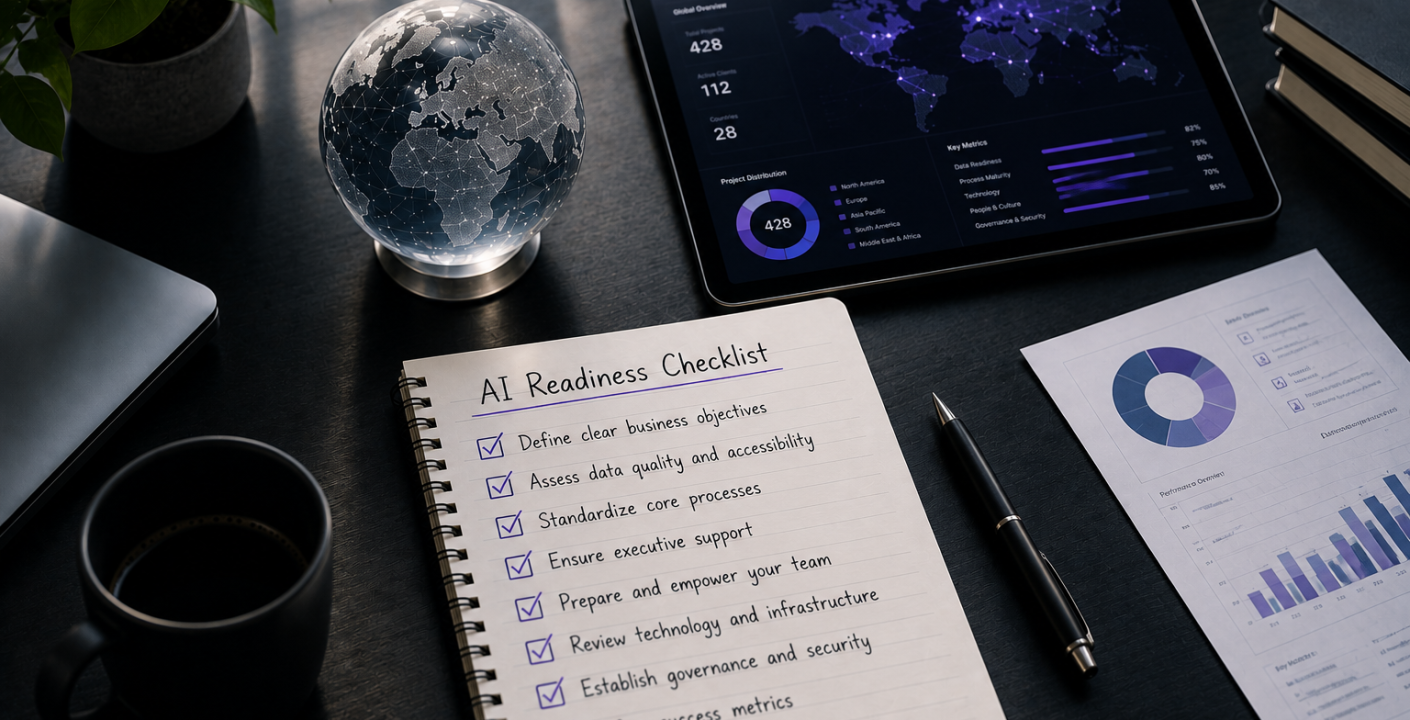
AI Readiness Checklist
Before launching an AI initiative, ask yourself:
✅ Business objectives are clearly defined
✅ High-quality business data is available
✅ Core processes are standardized
✅ Executive sponsorship exists
✅ Employees understand AI adoption
✅ Technology infrastructure supports integration
✅ Security and governance policies are established
✅ Success metrics have been identified
If several of these areas are missing, organizations should strengthen their foundations before investing heavily in AI.
Conclusion
Artificial Intelligence delivers the greatest value when organizations prepare for it properly.
Rather than viewing AI as a standalone technology project, successful businesses approach it as an organizational transformation supported by data, people, processes, and leadership.
A structured readiness assessment reduces implementation risks while increasing the likelihood of measurable business outcomes.
The organizations achieving the strongest AI results are rarely those with the newest technology—they are the ones with the strongest foundations.